
Food processing
Food processing and health
Evidence on unprocessed and ultraprocessed foods
- Author:
- NUTRIGENOVIA
- Published:
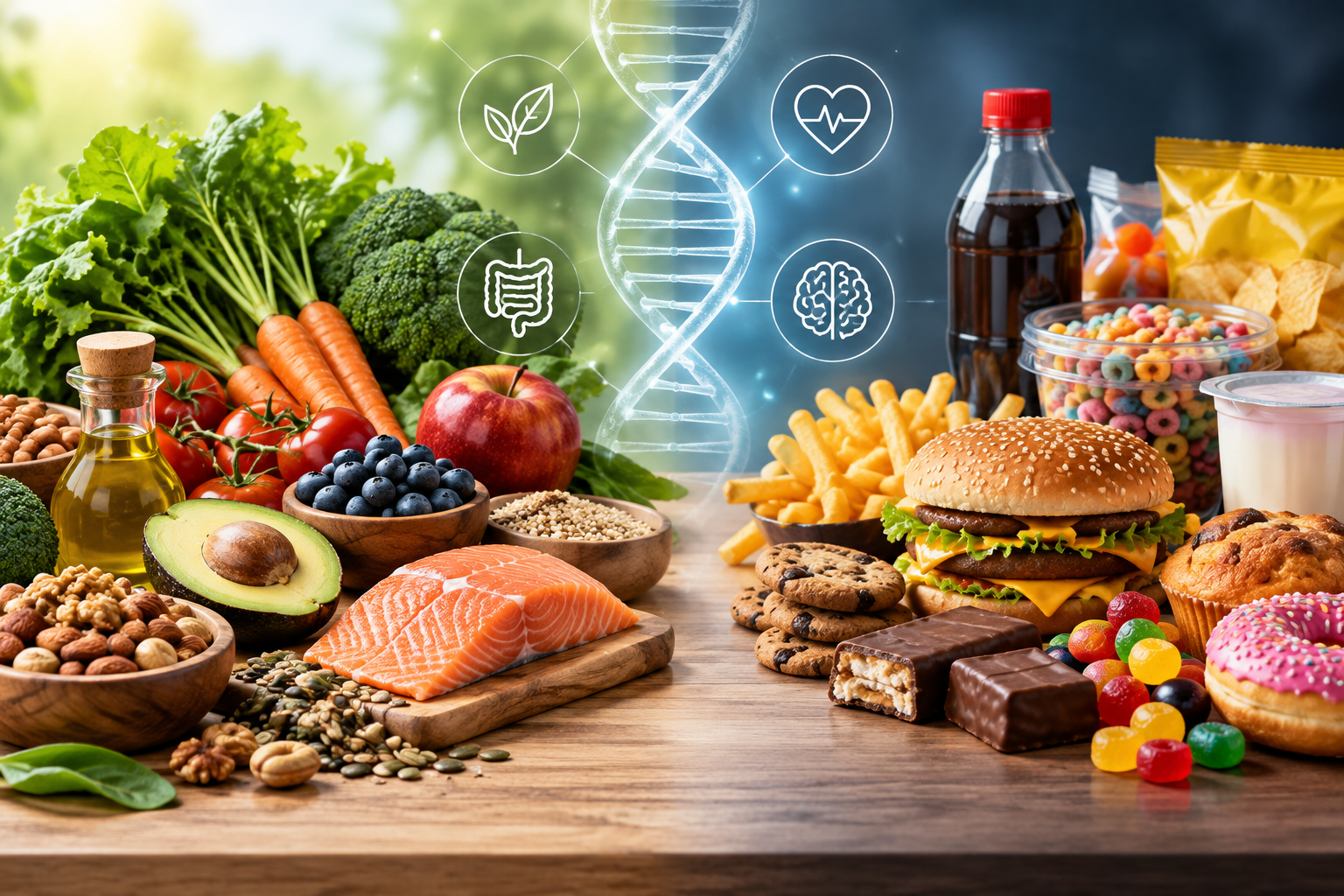
A fresh apple, a bag of plain frozen vegetables, a tin of beans and a packaged ready meal differ in both their preparation and their composition. The amount of processing alone cannot tell us how much fibre they provide, how quickly they can be eaten or how they fit into a diet.
Food processing can alter the physical structure of ingredients, reduce microbial hazards, extend shelf life, improve digestibility and change the accessibility of nutrients during digestion. Formulation can also add salt, sugars or fats, and changes in texture can make some foods easier to consume rapidly [1,5,10,14,16].
Higher consumption of ultra-processed foods has been associated with several adverse health outcomes in epidemiological research. Controlled feeding trials have also found differences in energy intake or weight change between selected ultra-processed and less processed diets. These studies examine different questions: long-term disease associations in populations and the effects of specific menus over shorter periods [2–4].
What counts as food processing
Food processing includes operations such as washing, peeling, chopping, grinding, heating, drying, freezing, fermenting and canning. Some take place in domestic kitchens; others use industrial equipment. NOVA is a food classification system developed by researchers at the University of São Paulo in Brazil. It divides foods into four groups according to the nature, extent and purpose of their processing, rather than ranking them solely by nutrient content. In NOVA, classification depends on the nature and purpose of the processes and the resulting formulation, rather than simply on whether a food has been changed from its original state [1].
The consequences depend on the food, the technique and the conditions used. Boiling vegetables can cause water-soluble nutrients to leach into cooking water. Heating legumes can improve protein digestibility and reduce heat-sensitive lectins and protease inhibitors. Pasteurisation reduces microbial hazards in milk. Freezing extends storage life, although blanching before freezing and subsequent storage can affect nutrient retention [10,12,14].
Processing can also change how quickly nutrients become accessible during digestion. Grinding a grain reduces particle size and disrupts its structure. Refining additionally removes bran and germ, often reducing fibre content; grinding alone does not necessarily do so. An intact grain and a finely milled product can therefore differ in digestive behaviour even when their starting ingredients are similar [5,16].
The NOVA classification
NOVA groups foods according to the nature, extent and purpose of their processing. It distinguishes four categories [1].
NOVA Group 1 comprises unprocessed or minimally processed foods, including fresh fruit, vegetables, eggs, plain pasteurised milk, dried beans and plain frozen vegetables. Processes such as freezing or pasteurisation do not by themselves move a food out of this group [1].
NOVA Group 2 comprises processed culinary ingredients, including oils, butter, sugar and salt. These are generally used to prepare, season or cook foods [1].
NOVA Group 3 comprises foods made mainly by adding culinary ingredients to Group 1 foods, such as vegetables canned with salt, traditional cheeses and breads made from flour, water, yeast and salt [1].
NOVA Group 4 comprises ultra-processed formulations, including many packaged snacks, soft drinks, confectionery and reconstituted meat products. Classification depends on the formulation and characteristic industrial ingredients or additives, rather than packaging alone [1].
NOVA does not classify foods according to their nutrient content alone. Its fourth group generally includes industrial formulations made with substances rarely used in domestic cooking, often combined with additives that modify flavour, texture or appearance. Preservatives used to maintain the properties of a food can also occur in other NOVA groups [1].
Two products with similar quantities of fat, sugar and sodium may belong to different NOVA groups because their ingredients and manufacturing processes differ. Nutrient profiling and NOVA describe overlapping but distinct properties of foods [1,6].
The processing history of a packaged food is not always apparent from its label, and products within one category can differ substantially in composition. An industrially produced wholegrain bread may be classified as ultra-processed because of its formulation, despite providing fibre and other nutrients. Production in a factory alone is not sufficient to assign that category [1,6,9].
NOVA is used to describe the food supply and population patterns of consumption. A 2026 perspective argues that variation among ultra-processed products does not invalidate its use in research or policy [9]. For an individual product, however, processing classification still needs to be considered alongside nutrient composition and its contribution to the broader diet [6].
Observational evidence on health
Epidemiological studies follow or compare people whose diets differ in their contribution from ultra-processed foods. They can investigate disease outcomes over periods that controlled feeding studies rarely cover [2].
A 2024 umbrella review in The BMJ assessed 45 pooled analyses with a combined reported sample size of 9,888,373. This total sums the samples across analyses and should not be read as a count of distinct individuals. Higher exposure to ultra-processed foods was associated with outcomes including cardiovascular disease-related mortality, type 2 diabetes and all-cause mortality [2].
All the pooled evidence in that review came from observational research. The authors rated four analyses as moderate certainty, 22 as low and 19 as very low using GRADE, a framework for assessing confidence in research findings. Their separate statistical credibility categories, including the label “convincing”, did not establish causation or imply high GRADE certainty [2].
People who consume large quantities of ultra-processed foods may also differ from those who consume less in income, education, smoking habits, physical activity, dietary patterns and access to food. Statistical adjustment cannot guarantee that these differences have been fully accounted for. Reverse causality is another possibility: illness or early symptoms may change what someone eats. Prospective studies, which assess diet before diagnosed disease, reduce this problem but do not remove every source of bias [2].
Dietary exposure is another source of uncertainty. Food-frequency questionnaires and dietary recalls may not capture enough detail to assign NOVA categories reliably. A report of eating bread, for instance, may omit the ingredients needed to distinguish between processing categories. The extent of this problem depends on the dietary instrument and classification procedures [1,6,9].
The large body of observational evidence warrants attention, but its pooled associations do not identify whether a particular manufacturing process, food constituent or accompanying behaviour caused disease. Those possibilities require different study designs [2].
Controlled dietary trials
Random assignment makes it possible to compare the effects of specified diets with less confounding from participants’ existing habits. Feeding trials are usually shorter and smaller than observational studies, and their conclusions apply to the menus and outcomes actually tested [3,4].
The 2019 metabolic ward experiment
In a randomised crossover trial published in Cell Metabolism, Kevin Hall and colleagues studied 20 adults at the US National Institutes of Health Clinical Center. Each participant consumed an ultra-processed diet for two weeks and an unprocessed diet for two weeks, in a randomly assigned order, with no washout between them [3].
Meals were designed to be broadly matched for presented calories, macronutrients, total sugar, sodium, fibre and energy density. The energy-density comparison included drinks, some containing added fibre. Excluding beverages, the presented meals were substantially more energy-dense in the ultra-processed condition: about 1.96 versus 1.06 kcal per gram. Other differences also remained. Participants could eat as much or as little as they wished [3].
Participants consumed an average of 508 additional kilocalories per day on the ultra-processed diet (standard error, 106 kcal per day; P = 0.0001). They gained approximately 0.9 kg during that phase and lost approximately 0.9 kg during the unprocessed phase [3].
Energy was consumed more rapidly during the ultra-processed phase, although participants’ ratings of meal pleasantness and familiarity did not differ significantly between the diets [3].
The experiment showed that the tested ultra-processed menu increased spontaneous energy intake under the ward conditions. All 20 participants completed both diets [3].
It did not isolate a single mechanism or an effect of processing independent of the foods’ other properties. Eating rate, energy density and food structure could have contributed. Greater pleasantness was not demonstrated by the participants’ ratings. The small sample, short duration and supervised setting also limit extrapolation to long-term health outside the ward [3].
The 2025 randomised dietary trial
A later randomised crossover trial in Nature Medicine compared minimally processed and ultra-processed diets designed to follow the United Kingdom’s Eatwell Guide [4].
The researchers randomised 55 adults with a body mass index of at least 25 and below 40 kg/m², whose habitual diets obtained at least half their energy from ultra-processed foods. Fifty participants contributed to the authors’ intention-to-treat analysis, having supplied the primary outcome for at least one diet. Forty-three completed both diets without withdrawal. Each intervention lasted eight weeks, separated by a four-week washout [4].
The primary outcome was the within-person difference in percentage weight change. Model-estimated mean changes were −2.06% on the minimally processed diet and −1.05% on the ultra-processed diet. The difference was −1.01 percentage points (95% confidence interval, −1.87 to −0.14; P = 0.024), indicating greater weight loss on the minimally processed diet [4].
Both menus followed healthy-eating guidance, so the comparison addressed whether their processing characteristics mattered within that setting. Participants received food at home and ate freely; they were not assigned equal calorie intakes [4].
The ultra-processed menu was more energy-dense, and flavour ratings and adherence also differed. A diet-order effect was observed, with less weight loss in the second intervention periods; possible carryover could not be excluded despite the washout. Most participants were women, and the eligibility criteria limit generalisation to other populations. The trial does not establish a ranking of every individual food or isolate processing from all other menu differences [4].
The intake and weight outcomes are effects of the menus as served. Attributing those differences requires information about their texture, structure and energy density [3,4].
Food structure eating rate and energy intake
Foods with similar nutrient compositions can behave differently during eating and digestion. The food matrix is the physical arrangement of nutrients within a food, including the cells and structures that contain them [5,8,16].
An intact grain, a coarsely milled grain and a finely ground flour differ in particle size and in how much their cellular structures have been disrupted. These differences can influence chewing, gastric breakdown and the accessibility of starch to digestive enzymes. Particle size is one influence among others, including starch properties and cooking conditions [5,16].
Texture affects the size of bites, the amount of chewing and the rate of eating. Less oral exposure during rapid eating can contribute to higher energy intake within a meal. Oral exposure is one influence on satiation, the processes that bring a meal to an end. The response also depends on properties such as energy density and food form. Processing categories contain widely different textures: a crisp snack, a soft dessert and a dense wholegrain product need not produce the same eating response [16].
In Hall and colleagues’ trial, faster energy consumption accompanied higher intake during the ultra-processed diet [3]. Eating rate is a plausible contributor, but the experiment did not determine how much of the difference was caused by texture.
Energy density describes the number of kilocalories per gram. A more energy-dense food delivers more energy for the same weight consumed, but this property does not map neatly onto processing categories. Nuts and oils are energy-dense, while some industrial formulations have low energy density [1,16].
Studies of food structure can help explain differences in digestion and intake. Those mechanisms must be examined at the level of the food or menu; assigning a NOVA category does not establish how quickly a particular food will be eaten or digested [5,16].
Nutritional and safety effects of processing
Cooking and preservation can make foods safer to eat and change their nutritional properties. The benefits and losses depend on the treatment rather than on a single degree of processing [10–14,18].
Raw legumes can contain lectins and protease inhibitors. Appropriate heat treatment reduces heat-sensitive compounds and can improve protein digestibility, although the response varies by legume and treatment [12]. Raw or undercooked kidney beans can cause acute illness from the lectin phytohaemagglutinin. Soaking does not replace adequate boiling [18].
Heat changes starch and protein structures. Cooking can gelatinise starch and make it more accessible to digestive enzymes. Protein denaturation can also improve enzyme access, although prolonged or severe heating may produce changes that reduce digestibility. These effects depend on the food and treatment [12,16].
Micronutrient effects are more variable. Vitamin C and some B vitamins can be lost through heating, oxidation or leaching into water [10]. Disrupting plant tissues can increase carotenoid bioaccessibility, meaning the fraction released and made available for absorption during digestion. This is distinct from bioavailability, which also concerns absorption and subsequent use in the body. Nutrient retention, the food matrix, processing conditions, accompanying fat [19] and the particular carotenoid all affect the outcome [5,11,16].
Freezing slows deterioration and makes vegetables available beyond their harvest season. Nutrient changes can occur during blanching, storage and final cooking. Canning produces shelf-stable foods but can reduce heat-sensitive vitamins; other components, including fibre and many minerals, are often retained. Added salt or sugar varies between products. In milk, pasteurisation reduces microbial risks with little effect on overall nutritional quality [10,11,14].
Fermentation changes food through microbial growth and enzymatic activity. Its effects on acidity, composition and nutrient availability depend on the organisms, substrate and production conditions. Some fermented foods are subsequently heated or filtered, so live microorganisms need not remain at consumption. Nor does fermentation alone demonstrate a clinical benefit; evidence is needed for the particular product and outcome [13].
Plain frozen vegetables can contribute to dietary quality, and canned beans provide fibre and protein. Pasteurised milk retains important nutrients while offering greater microbial safety than raw milk. These foods show why avoiding all processing would exclude useful dietary options [10,11,14,17].
Food additives and the health evidence
Preservatives, emulsifiers, stabilisers, colours and sweeteners serve different technological functions and have different biological properties. Their presence cannot be treated as evidence of a common physiological effect [1,7].
Some additives have been investigated for effects on intestinal physiology and the microbiota. Cell experiments and animal models can help identify mechanisms, but their findings do not establish what happens at ordinary human dietary exposures [7].
Human evidence includes a small controlled-feeding study of carboxymethylcellulose, or CMC, an emulsifier and thickener. Sixteen healthy adults received an emulsifier-free diet: seven also consumed 15 g of CMC daily and nine received the control diet, for 11 days. CMC altered the composition of gut microbes and faecal metabolites and modestly increased post-meal abdominal discomfort [7].
The authors noted that the dose probably exceeded most people’s CMC intake. The short study did not establish chronic disease risk or effects of other emulsifiers [7]. Within NOVA, some additives used to modify sensory properties are markers of ultra-processed formulations; the presence of a preservative alone is not sufficient to assign Group 4 [1].
Whole-diet studies cannot apportion an observed association precisely among additives, nutrient composition, food structure, eating behaviour and displacement of other foods. Trials of individual additives address a narrower question and cannot be generalised to all ultra-processed products [2–4,7].
Nutrient composition and dietary processing
National dietary surveys and meta-analytic evidence link higher ultra-processed food intake with more free sugars and saturated fat and less fibre, alongside lower consumption of several minimally processed plant foods. Sodium is also often higher in these dietary patterns, although this is not a uniform finding across all products or populations [2,15]. These differences can contribute to associations with poorer health.
The 2025 Eatwell Guide trial compared menus meeting the same broad recommendations, yet weight loss differed [4]. Meeting guidance did not make the diets identical: their energy density differed, and participants’ actual intakes were not fixed. The result therefore cannot quantify a health effect of processing independent of all nutritional differences.
An ultra-processed food with a favourable nutrient profile may help meet particular dietary needs. Its fibre, protein, micronutrients and salt content remain relevant when comparing it with alternatives. A minimally processed food’s contribution likewise depends on the amount eaten and the rest of the diet [6,17].
Assessment can combine nutrient composition with information about physical structure, preparation and usual consumption. Neither a processing category nor an isolated nutrient value describes every aspect of a food’s effects [5,6,16].
Implications for food choices
Vegetables, fruit, legumes, wholegrains, nuts and other minimally processed foods can supply fibre and essential nutrients within a varied diet. Dietary guidance also includes appropriately processed staples, rather than requiring all foods to be fresh or raw [17].
Frozen vegetables, canned legumes and processed dairy products can contribute to these dietary goals. Check the product’s composition, including added salt or sugar where relevant, and its role in meals [10,11,14,17].
For packaged foods, the ingredient list and nutrition declaration provide complementary information. Ingredients can help identify an ultra-processed formulation, while the nutrition declaration shows quantities of salt, saturated fat and other declared nutrients. Fibre is also useful for comparison when it is listed. A label may not reveal enough about manufacturing for a certain NOVA assignment [1,6].
The overall pattern matters when interpreting the research. Diets dominated by energy-dense products that can be consumed quickly differ from diets containing a few industrial formulations alongside vegetables, legumes, fruit and wholegrains. Existing evidence does not define a universal safe proportion of ultra-processed foods or prove that these patterns have equivalent effects [2–4,16].
Affordability, storage, preparation time and food availability constrain everyday choices. Recommendations can accommodate frozen and canned foods, which may make a varied diet more accessible, while still considering the ingredients and nutrient composition of individual products [6,17].
Questions for further research
Long-term randomised trials of whole dietary patterns are difficult to conduct because participants must follow assigned menus for extended periods. Outside supervised settings, adherence and actual intake are harder to measure and control [3,4].
The trials discussed here measured short-term energy intake or weight change. They did not establish long-term effects of every ultra-processed food category on cardiovascular disease, cancer or mortality [3,4].
Texture, eating rate, energy density, nutrient composition, food structure, additives and the displacement of other foods may contribute in different proportions. Studies that manipulate one characteristic while holding others as constant as possible would help separate these influences [2,5,7,16].
Classification methods also need scrutiny. Nutrient profiles, manufacturing details and the precision of dietary records affect what researchers can infer about particular products and populations [1,6,9].
A useful experimental comparison would specify the processing operation and the resulting change in the food, then measure digestion, intake or another defined outcome. This would complement research on whole dietary patterns rather than assume that every food within a broad category acts through one mechanism [5,16].
Conclusions
Food processing alters texture, digestibility, nutrient accessibility, storage life and microbial safety. These effects can be beneficial, adverse or mixed, depending on the food and the operation [5,10–14,16].
Higher ultra-processed food consumption is associated with several adverse health outcomes in observational studies. Controlled trials demonstrate differences in intake or weight change for specific dietary comparisons, without establishing which single property caused them or the long-term effects of every ultra-processed product [2–4].
Plain frozen vegetables, cooked or canned beans and pasteurised milk can all contribute useful nutrients. Their composition, preparation and place in meals matter when choosing between products. The health associations studied in populations concern patterns of consumption over time; they do not provide a complete nutritional judgement of every item on a shopping list [2,6,10,11,14,17,18].
References
- 1. Monteiro CA, Cannon G, Levy RB, et al. Ultra-processed foods: what they are and how to identify them. Public Health Nutrition. 2019;22(5):936–941. https://doi.org/10.1017/S1368980018003762
- 2. Lane MM, Gamage E, Du S, et al. Ultra-processed food exposure and adverse health outcomes: umbrella review of epidemiological meta-analyses. BMJ. 2024;384:e077310. https://doi.org/10.1136/bmj-2023-077310
- 3. Hall KD, Ayuketah A, Brychta R, et al. Ultra-Processed Diets Cause Excess Calorie Intake and Weight Gain: An Inpatient Randomized Controlled Trial of Ad Libitum Food Intake. Cell Metabolism. 2019;30(1):67–77.e3. https://doi.org/10.1016/j.cmet.2019.05.008
- 4. Dicken SJ, Jassil FC, Brown A, et al. Ultraprocessed or minimally processed diets following healthy dietary guidelines on weight and cardiometabolic health: a randomized, crossover trial. Nature Medicine. 2025;31(10):3297–3308. https://doi.org/10.1038/s41591-025-03842-0
- 5. Capuano E, Janssen AEM. Food Matrix and Macronutrient Digestion. Annual Review of Food Science and Technology. 2021;12:193–212. https://doi.org/10.1146/annurev-food-032519-051646
- 6. Tompa O, Kiss A, Soós S, Lakner Z, Raner A, Kasza G, Szakos D. Fifteen Years of NOVA Food-Processing Classification: “Friend or Foe” Among Sustainable Diet Indicators? A Scoping Review. Nutrition Reviews. 2025;83(4):771–791. https://doi.org/10.1093/nutrit/nuae207
- 7. Chassaing B, Compher C, Bonhomme B, et al. Randomized Controlled-Feeding Study of Dietary Emulsifier Carboxymethylcellulose Reveals Detrimental Impacts on the Gut Microbiota and Metabolome. Gastroenterology. 2022;162(3):743–756. https://doi.org/10.1053/j.gastro.2021.11.006
- 8. Holland C, Ryden P, Edwards CH, Grundy MM-L. Plant Cell Walls: Impact on Nutrient Bioaccessibility and Digestibility. Foods. 2020;9(2):201. https://doi.org/10.3390/foods9020201
- 9. Khandpur N, Geleijnse JM, Kamphuis CBM, et al. The validity and utility of Nova and the concept of ultra-processed foods for science and policy. Nature Food. 2026;7(6):513–520. https://doi.org/10.1038/s43016-026-01371-8
- 10. Rickman JC, Barrett DM, Bruhn CM. Nutritional comparison of fresh, frozen and canned fruits and vegetables. Part 1. Vitamins C and B and phenolic compounds. Journal of the Science of Food and Agriculture. 2007;87(6):930–944. https://doi.org/10.1002/jsfa.2825
- 11. Rickman JC, Bruhn CM, Barrett DM. Nutritional comparison of fresh, frozen, and canned fruits and vegetables II. Vitamin A and carotenoids, vitamin E, minerals and fiber. Journal of the Science of Food and Agriculture. 2007;87(7):1185–1196. https://doi.org/10.1002/jsfa.2824
- 12. Ohanenye IC, Ekezie F-GC, Sarteshnizi RA, Boachie RT, Emenike CU, Sun X, Nwachukwu ID, Udenigwe CC. Legume Seed Protein Digestibility as Influenced by Traditional and Emerging Physical Processing Technologies. Foods. 2022;11(15):2299. https://doi.org/10.3390/foods11152299
- 13. Marco ML, Sanders ME, Gänzle M, et al. The International Scientific Association for Probiotics and Prebiotics (ISAPP) consensus statement on fermented foods. Nature Reviews Gastroenterology & Hepatology. 2021;18(3):196–208. https://doi.org/10.1038/s41575-020-00390-5
- 14. US Food and Drug Administration. Raw Milk Misconceptions and the Danger of Raw Milk Consumption. Web resource. Accessed 14 October 2026. https://www.fda.gov/food/buy-store-serve-safe-food/raw-milk-misconceptions-and-danger-raw-milk-consumption
- 15. Martini D, Godos J, Bonaccio M, Vitaglione P, Grosso G. Ultra-Processed Foods and Nutritional Dietary Profile: A Meta-Analysis of Nationally Representative Samples. Nutrients. 2021;13(10):3390. https://doi.org/10.3390/nu13103390
- 16. Forde CG, Bolhuis D. Interrelations Between Food Form, Texture, and Matrix Influence Energy Intake and Metabolic Responses. Current Nutrition Reports. 2022;11(2):124–132. https://doi.org/10.1007/s13668-022-00413-4
- 17. Office for Health Improvement and Disparities. Healthy eating: applying All Our Health. GOV.UK. Web resource. Accessed 14 October 2026. https://www.gov.uk/government/publications/healthy-eating-applying-all-our-health/healthy-eating-applying-all-our-health
- 18. US Food and Drug Administration. Natural Toxins in Food. Web resource. Accessed 14 October 2026. https://www.fda.gov/food/chemical-contaminants-pesticides/natural-toxins-food
- 19. White WS, Zhou Y, Crane A, Dixon P, Quadt F, Flendrig LM. Modeling the dose effects of soybean oil in salad dressing on carotenoid and fat-soluble vitamin bioavailability in salad vegetables. The American Journal of Clinical Nutrition. 2017;106(4):1041–1051. https://doi.org/10.3945/ajcn.117.153635