Micronutrients
Vitamin A in Food: How Cooking Changes What Our Bodies Can Absorb
A carrot contains β-carotene before it is washed, chopped or cooked. The amount present does not by itself establish how much will be absorbed and converted to vitamin A.
- Author:
- NUTRIGENOVIA
- Published:
Introduction
A carrot contains β-carotene before it is washed, chopped or cooked. The amount present does not by itself establish how much will be absorbed and converted to vitamin A. Some of the pigment remains enclosed within plant cells, some may be released during food preparation, and some may be chemically altered or lost before the meal is eaten.
Cooking can influence all three processes. Heat may damage carotenoids while simultaneously making those that remain more accessible during digestion. The outcome depends on the food, its physical structure, the processing conditions and the composition of the meal.
The forms of vitamin A differ in their digestion and metabolism.
Forms of vitamin A
Vitamin A is a fat-soluble micronutrient required for vision, immune function, cellular differentiation, reproduction and normal growth. Its biological functions involve several related compounds, including retinol, retinal and retinoic acid.
In food, vitamin A comes from two main groups of compounds.
Preformed vitamin A occurs in animal-derived foods, principally as retinyl esters and retinol. These compounds can supply vitamin A without first undergoing the carotenoid-to-retinal conversion required for plant-derived precursors.
Provitamin A carotenoids occur in plant foods. β-Carotene, α-carotene and β-cryptoxanthin can be converted into vitamin A, although they differ in their vitamin A activity. Many other dietary carotenoids, including lycopene and lutein, do not have provitamin A activity.
A carrot may contain substantial β-carotene, but its vitamin A contribution depends on how efficiently that carotenoid is released, absorbed and converted. The same amount of preformed vitamin A from an animal-derived food follows a different metabolic route.
Dietary recommendations therefore use retinol activity equivalents (RAE), a unit that accounts for differences in vitamin A activity. Under the conventional dietary conversion factors, 1 microgram RAE corresponds to 1 microgram of retinol, 12 micrograms of dietary β-carotene or 24 micrograms of dietary α-carotene or β-cryptoxanthin. These are population-level conversion factors, not exact predictions of an individual's absorption from a particular meal.
For adults, the US recommended dietary allowance is 900 micrograms RAE per day for men and 700 micrograms RAE for women, with different requirements during pregnancy and lactation. [1]
Which foods provide vitamin A?
The richest dietary sources differ substantially in both the amount and chemical form of the nutrient they contain.
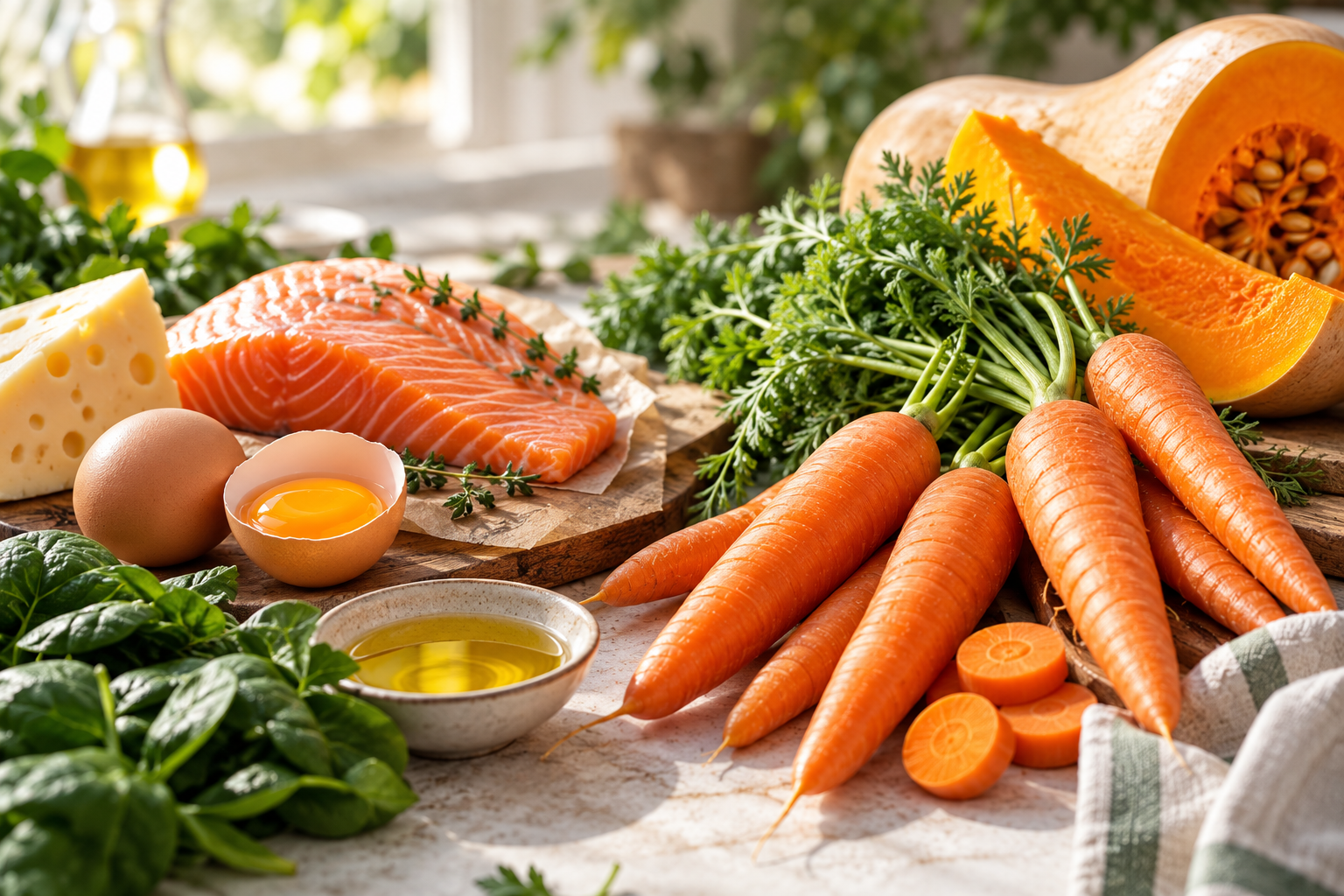
Animal liver is an exceptionally concentrated source of preformed vitamin A. Eggs, certain fish and dairy products contribute smaller quantities, while fortified foods may provide additional amounts depending on the country and product.
Among plant foods, sweet potatoes, carrots, pumpkin and dark-green leafy vegetables are important sources of provitamin A carotenoids. Spinach, for example, contains carotenoids despite its green appearance: chlorophyll masks much of the orange-yellow pigmentation.
Concentrations vary with cultivar, animal diet, growing conditions and processing; the amount in a serving also depends on serving size. A comparison based only on food weight may also be misleading because cooking changes water content.
Food-composition tables are useful for estimating dietary intake, but they cannot establish how much vitamin A an individual will absorb from a specific meal. [1]
| Food | Main vitamin A form or precursor |
|---|---|
| Beef or chicken liver | Preformed vitamin A |
| Eggs | Preformed vitamin A |
| Dairy products | Preformed vitamin A; amounts vary |
| Carrots | β-Carotene, α-carotene |
| Orange-fleshed sweet potatoes | Predominantly β-carotene |
| Pumpkin | Provitamin A carotenoids; variety-dependent |
| Spinach and kale | β-Carotene |
| Mango and apricots | Provitamin A carotenoids |
Table source: NIH ODS [1]; carrot carotenoids also documented in [7].
What happens to carotenoids when food is cooked?
Carotenoids contain chains of conjugated double bonds that contribute to their colour and chemical behaviour. These structures are vulnerable to reactions involving oxygen, light and heat.
During processing, carotenoids may undergo oxidation, cleavage or changes in molecular geometry known as isomerisation. Some of these reactions reduce the quantity of intact carotenoids, while others change the proportions of different isomers.
The magnitude of these changes depends on the carotenoid, the surrounding food matrix, temperature, oxygen exposure and processing duration.
The term food matrix describes the physical and chemical environment in which nutrients are contained. In vegetables, carotenoids are located within cellular structures, including plastids, and their release depends partly on the disruption of those structures.
Heating softens plant tissues and can alter cell walls and membranes. Chopping, grinding and pureeing may further increase the surface area exposed to digestive processes.
Consequently, a processed vegetable can contain less total β-carotene than its raw counterpart while allowing a greater proportion of the remaining carotenoid to become accessible during digestion.
An increase in extractable carotenoid content after cooking does not necessarily mean that cooking created additional carotenoid. It may reflect improved release from the plant tissue during laboratory analysis.
A 2023 comprehensive review by Meléndez-Martínez and colleagues examined changes in carotenoid composition during processing and storage. The authors documented degradation, isomerisation and differences in extractability. [2]
What studies involving carrots tell us
Carrots are frequently used in carotenoid research because their β-carotene content is relatively high and their physical structure can be altered through ordinary food preparation.
In a human study published in 2003 in the European Journal of Nutrition, Livny and colleagues compared β-carotene from raw, chopped carrots with β-carotene from cooked, pureed carrots.
Eight volunteers with ileostomies consumed test meals containing 15 mg of β-carotene. The meals also contained skimmed-milk yoghurt and 40 g of sunflower oil. Investigators compared the combined effects of cooking and pureeing against raw chopping; these interventions were not isolated. [3]
Using a carotenoid mass balance, the investigators estimated greater β-carotene absorption from cooked, pureed carrots than from raw, chopped carrots. [3] The participants had ileostomies, the meals contained a substantial quantity of added oil, and the experimental setting differed from ordinary mixed meals.
These results do not establish the effects of other cooking methods or the amount converted to vitamin A. They support a narrower conclusion: disrupting the carrot matrix can alter β-carotene availability during digestion. [3]
This is consistent with later food-matrix research, which identifies cell structure, particle size and interactions with other food components as important determinants of carotenoid bioaccessibility. [4]
Why dietary fat changes absorption
Carotenoids are lipophilic compounds. Their absorption depends partly on digestive processes that also handle dietary lipids.
After a meal reaches the small intestine, bile components and products of fat digestion help form mixed micelles. These microscopic structures carry lipophilic substances through the aqueous environment of the intestinal lumen toward the intestinal surface.
For carotenoids, incorporation into mixed micelles is an important step before uptake by intestinal cells.
Human meal studies indicate that dietary fat can improve carotenoid absorption under the tested conditions. Fat type and emulsification can also influence measured responses, although these effects are not uniform across individual carotenoids. [7, 9, 10]
β-Carotene absorption may differ when a carrot is eaten with a meal containing fat rather than without fat. [7, 9] The size of that difference cannot be predicted reliably from the carrot's β-carotene content alone.
Fat also interacts with the effects of food processing. Pureeing a vegetable may release carotenoids from cellular structures, but those compounds must still become available for incorporation into micelles and subsequent intestinal uptake.
Bioaccessibility and bioavailability are not interchangeable terms.
Bioaccessibility describes the fraction of a compound released from the food matrix and made available for absorption during digestion. Bioavailability concerns the fraction that is absorbed and becomes available for use or storage in the body.
Laboratory digestion experiments can estimate bioaccessibility. They cannot, by themselves, demonstrate how much vitamin A a person ultimately obtains. [4]
How boiling affects provitamin A carotenoids
The effect of boiling on provitamin A carotenoids depends on the food and processing conditions. [2]
Provitamin A carotenoids are poorly soluble in water, so their behaviour differs from that of water-soluble nutrients such as vitamin C. Losses during boiling cannot simply be explained by assuming that β-carotene dissolves into the cooking water.
Thermal degradation, oxidation, isomerisation and physical loss of food material may contribute to changes in carotenoid content. [2]
Water loss and water uptake also complicate comparisons. If a vegetable loses water during cooking, its carotenoid concentration per 100 grams may increase even without an increase in the absolute quantity of carotenoid. If it absorbs water, the concentration may decrease through dilution.
A proper assessment of nutrient retention must therefore consider both nutrient concentration and changes in food weight.
One useful measure is true retention, which compares the total amount of a nutrient remaining after cooking with the amount originally present, accounting for changes in mass. [12]
The same principle applies when comparing roasting, steaming, boiling or other methods. Results expressed only per 100 grams of cooked food may give a misleading impression of the actual nutrient loss.
The available evidence does not establish one cooking method that maximises both carotenoid retention and absorption across all vegetables. [2, 4]
What happens during storage?
After harvest, vegetables remain biologically active, and their chemical composition may continue to change. [13] Storage temperature, light exposure, oxygen availability, moisture and duration influence the stability of different food constituents.
Carotenoids are susceptible to oxidative reactions, but their stability depends partly on whether they remain protected within intact cellular structures. [2, 4]
Cutting or pureeing increases tissue disruption and may expose carotenoids to oxygen. Processing can therefore improve their accessibility while also changing their susceptibility to degradation during subsequent storage.
Low temperatures generally slow many degradation reactions, although blanching before freezing and frozen-storage duration may affect carotenoid retention in food-specific ways. [14, 15]
For preformed vitamin A, stability also depends on its chemical form and the surrounding food system. Retinol and retinyl esters are sensitive to oxidation and other degradation pathways, but results from fortified products or isolated compounds cannot automatically be applied to intact foods. [5]
Storage recommendations should therefore be based on the particular food rather than on a universal rule that fresh, frozen or cooked foods always retain the most nutrients.
Why vitamin A yield from β-carotene differs between people
Absorption and conversion also depend on human physiology.
After intestinal uptake, some β-carotene can be cleaved by the enzyme β-carotene oxygenase 1, encoded by the BCO1 gene, also commonly referred to as BCMO1. [16] This reaction produces retinal, which can subsequently be reduced to retinol or participate in other vitamin A metabolic pathways.
Genetic variants affecting BCO1 activity have been associated with differences in circulating carotenoid concentrations and conversion efficiency. [8] Nutritional status and physiological regulation also influence carotenoid metabolism; mechanistic studies indicate feedback regulation, but do not establish individual dietary requirements. [17]
This helps explain why two people consuming similar quantities of β-carotene may not obtain identical amounts of vitamin A.
These findings do not establish that routine genetic testing can determine an individual's vitamin A requirements. The relationship between genotype, dietary intake and vitamin A status is more complex than a single variant-based prediction.
Population-level dietary recommendations remain the appropriate reference for most healthy people. [1]
Can more vitamin A be harmful?
Excess-intake risks differ between preformed vitamin A and provitamin A carotenoids.
Preformed vitamin A can accumulate in the body, particularly in the liver. Chronically excessive intake can cause toxicity.
For adults aged 19 years and older, the US tolerable upper intake level is 3,000 micrograms RAE per day of preformed vitamin A from food and supplements combined. [1] This limit does not apply to dietary β-carotene in the same way.
Even small servings of liver may contain large amounts of preformed vitamin A.
Excessive preformed vitamin A intake during pregnancy is associated with a risk of fetal abnormalities. Pregnant individuals should avoid excessive preformed vitamin A and follow appropriate clinical guidance. UK NHS guidance advises avoiding liver and liver products during pregnancy, as well as supplements containing retinol. [11]
These concerns do not justify avoiding ordinary carotenoid-rich vegetables. Their vitamin A precursors are handled differently, and the body regulates their conversion. [1, 6] High-dose β-carotene supplements are a separate concern: trials have found increased lung-cancer risk in smokers and certain other high-risk groups. [1]
Food preparation and vitamin A availability
The nutritional contribution of a vegetable cannot be established by measuring its carotenoid concentration in isolation.
Its physical structure influences how readily carotenoids are released. Cooking and mechanical processing may alter that structure, while oxygen, heat and storage conditions may reduce the amount remaining. The composition of the meal then affects micellar incorporation and intestinal absorption.
For carrots, pumpkin and other carotenoid-rich vegetables, cooked and mechanically softened preparations can be useful dietary options, particularly when consumed as part of a meal containing fat. Raw vegetables also provide provitamin A carotenoids.
Laboratory retention measurements, simulated digestion studies and human absorption trials answer different questions and should not be treated as equivalent evidence.
References
- 1. NIH Office of Dietary Supplements. Vitamin A and Carotenoids — Health Professional Fact Sheet. https://ods.od.nih.gov/factsheets/VitaminA-HealthProfessional/ (Updated 10 March 2025; accessed 9 October 2026).
- 2. Meléndez-Martínez AJ, Esquivel P, Rodriguez-Amaya DB (2023). Comprehensive review on carotenoid composition: Transformations during processing and storage of foods. Food Research International 169:112773. https://doi.org/10.1016/j.foodres.2023.112773
- 3. Livny O, Reifen R, Levy I, Madar Z, Faulks R, Southon S, Schwartz B (2003). Beta-carotene bioavailability from differently processed carrot meals in human ileostomy volunteers. European Journal of Nutrition 42(6):338–345. https://doi.org/10.1007/s00394-003-0430-6
- 4. Zhang Y, Li R, Xu Z, Fan H, Xu X, Pan S, Liu F (2024). Recent advances in the effects of food microstructure and matrix components on the bioaccessibility of carotenoids. Trends in Food Science & Technology 143:104301. https://doi.org/10.1016/j.tifs.2023.104301
- 5. Abeywardana L, Gamage TV, Singh TK, Zhao S, Logan A, Kong L (2026). Degradation Mechanisms, Encapsulation-Based Stabilization, and Analytical Detection of Vitamin A. Journal of the American Oil Chemists' Society 103(9):1079–1097. https://doi.org/10.1002/aocs.70119
- 6. NIH Office of Dietary Supplements. Dietary Supplements and Life Stages: Pregnancy. https://ods.od.nih.gov/factsheets/Pregnancy-HealthProfessional/ (Updated 3 April 2025; accessed 9 October 2026).
- 7. Kopec RE, Cooperstone JL, Schweiggert RM, Young GS, Harrison EH, Francis DM, Clinton SK, Schwartz SJ (2014). Avocado consumption enhances human postprandial provitamin A absorption and conversion from a novel high-β-carotene tomato sauce and from carrots. Journal of Nutrition 144(8):1158–1166. https://doi.org/10.3945/jn.113.187674
- 8. Leung WC, Hessel S, Méplan C, Flint J, Oberhauser V, Tourniaire F, Hesketh JE, von Lintig J, Lietz G (2009). Two common single nucleotide polymorphisms in the gene encoding beta-carotene 15,15′-monoxygenase alter beta-carotene metabolism in female volunteers. FASEB Journal 23(4):1041–1053. https://doi.org/10.1096/fj.08-121962
- 9. Unlu NZ, Bohn T, Clinton SK, Schwartz SJ (2005). Carotenoid absorption from salad and salsa by humans is enhanced by the addition of avocado or avocado oil. Journal of Nutrition 135(3):431–436. https://doi.org/10.1093/jn/135.3.431
- 10. Yao Y, Yang Z, Yin B, Goh HM, Toh DWK, Kim JE (2023). Effects of dietary fat type and emulsification on carotenoid absorption: a randomized crossover trial. American Journal of Clinical Nutrition 117(5):1017–1025. https://doi.org/10.1016/j.ajcnut.2023.03.011
- 11. NHS. Pregnancy vitamins and supplements. Page reviewed 3 June 2026; accessed 9 October 2026. https://www.nhs.uk/pregnancy/keeping-well/pregnancy-vitamins-and-supplements/
- 12. USDA Agricultural Research Service. USDA Table of Nutrient Retention Factors, Release 6. December 2007. Introduction and Methods (true-retention formula), p. 1 (PDF page 3). Accessed 9 October 2026. https://www.ars.usda.gov/ARSUserFiles/80400530/pdf/retn06.pdf
- 13. Harris SR (1988). Production is only half the battle: A training manual in fresh produce marketing for the Eastern Caribbean. FAO, Bridgetown, Barbados, December 1988. Chapter 2: Fresh produce. Accessed 9 October 2026. https://www.fao.org/4/x5014e/X5014e04.htm
- 14. Behsnilian D, Mayer-Miebach E (2017). Impact of blanching, freezing and frozen storage on the carotenoid profile of carrot slices (Daucus carota L. cv. Nutri Red). Food Control 73(B):761–767. https://doi.org/10.1016/j.foodcont.2016.09.045
- 15. Bouzari A, Holstege D, Barrett DM (2015). Vitamin retention in eight fruits and vegetables: a comparison of refrigerated and frozen storage. Journal of Agricultural and Food Chemistry 63(3):957–962. https://doi.org/10.1021/jf5058793
- 16. NCBI NIH Genetic Testing Registry. BCO1 beta-carotene oxygenase 1 (human gene ID 53630; BCMO1 alias). Updated 13 September 2026; accessed 9 October 2026. https://www.ncbi.nlm.nih.gov/gtr/genes/53630/
- 17. Lobo GP, Hessel S, Eichinger A, Noy N, Moise AR, Wyss A, Palczewski K, von Lintig J (2010). ISX is a retinoic acid-sensitive gatekeeper that controls intestinal β,β-carotene absorption and vitamin A production. FASEB Journal 24(6):1656–1666. https://doi.org/10.1096/fj.09-150995