
The Meal Begins Before Nutrient Absorption
How sight, smell, taste and oral sensing can begin shaping physiological responses to food before absorbed nutrients produce the main systemic response to a meal.
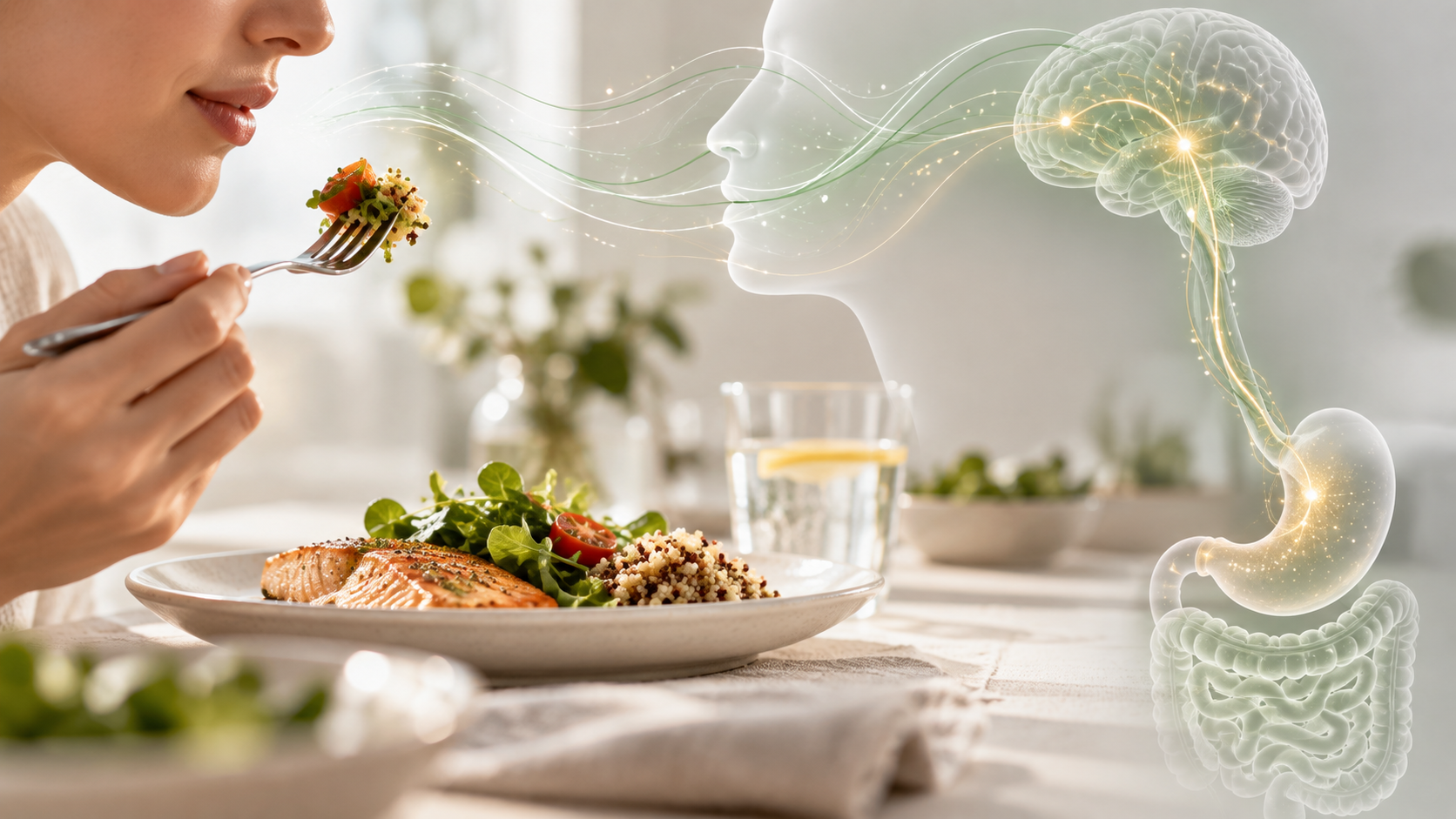
We often picture eating as a tidy sequence: we eat, digest and absorb food, and then the body responds.
But the response can begin earlier.
The sight and smell of food, its first taste and especially its presence in the mouth can already change what is happening inside the body — before absorbed nutrients produce the main systemic response to the meal.
These early responses have a name: cephalic-phase responses.
But “early” does not automatically mean “cephalic”. What defines the cephalic phase is where the signal begins — primarily in the head and mouth — and how that information is carried through neural pathways towards the digestive system.
The mouth is already part of digestion
The easiest example is something we have all noticed: food can make us salivate before we swallow it.
That is already part of the physiological response to eating.
Saliva helps moisten food and form a bolus for swallowing. It allows compounds from food to reach taste receptors, while salivary amylase begins breaking down starch. Saliva also helps protect the tissues and teeth in the mouth.
So by the time a bite reaches the stomach, its processing has already begun.
But the response does not necessarily stop at the mouth.
What happens if you taste food but never swallow it?
Researchers have found a clever way to investigate this.
It is called modified sham feeding.
Participants see, smell, taste and chew food — but do not swallow it.
Because the food never enters the stomach, researchers can examine some of the responses generated by sensory and oral stimulation separately from those produced later by food inside the gastrointestinal tract.
These experiments are usually small and highly controlled, but they have revealed something fascinating.
Under some conditions, tasting and chewing food without swallowing it can change gastric activity, pancreatic secretion and certain hormonal signals.
The nervous system appears to be an important part of this communication. Parasympathetic pathways involving the vagus nerve connect the brain with several digestive organs, and experiments that blocked part of this signalling also blocked some of the early digestive responses.
But the body does not simply switch every digestive process “on” at once.
Different responses behave differently.
In one human sham-feeding experiment, for example, pancreatic polypeptide increased while insulin, glucagon, GLP-1, GIP and ghrelin showed no detectable cephalic response.
That selectivity is one reason why it is misleading to talk about “the cephalic response” as though it were one uniform event.
And then there is insulin
The cephalic-phase insulin response, or CPIR, has been debated for decades.
The idea is straightforward: can sensory or oral exposure to food trigger a small, early release of insulin before the main insulin response driven by absorbed nutrients and rising blood glucose?
Human research suggests that it can.
But not reliably.
A 2020 systematic review and meta-analysis found an overall early insulin response across the available human evidence. A separate systematic review from the same year shows just how variable that response can be.
Across 119 experimental conditions, an insulin increase of at least 1 μIU/mL was observed in 41%.
A statistically significant increase from baseline occurred in only 22%.
Among the conditions in which a response was detected, the median increase was 2.5 μIU/mL, approximately 30% above baseline, with the peak occurring on average at around five minutes.
In other words, CPIR appears to be a real physiological phenomenon.
It is simply not a universal one.
Why are the results so inconsistent?
Part of the answer may lie in what researchers actually ask the body to respond to.
Seeing a photograph of food is not physiologically identical to smelling it. Smelling food is not the same as tasting it. And tasting something is not the same as chewing and swallowing an entire meal.
Studies also differ in when they collect blood samples, how they define CPIR and what foods or liquids they use.
More recent experiments have strengthened the evidence for the importance of what happens inside the mouth.
In one small controlled human study, oral exposure to glucose and maltodextrin produced early insulin responses. When researchers interfered with the relevant taste or oral digestion, those responses were reduced or disappeared.
Another small experiment found that different sweet stimuli produced responses of different sizes — with substantial differences between individuals.
So CPIR can occur.
But seeing a meal does not mean that everyone's pancreas immediately releases insulin. The response depends on the stimulus, the experimental conditions and the individual.
The cephalic phase is not a stopwatch
It is tempting to imagine a neat dividing line:
first the cephalic phase, then digestion, then absorption, then metabolism.
The physiology is messier — and more interesting.
Cephalic responses are identified mainly by where their signals originate and how those signals travel, not by an exact number of seconds before or after swallowing.
Once food is swallowed, new information begins arriving from the stomach and intestine. The stomach stretches. Nutrients interact with intestinal sensing mechanisms. Gastrointestinal hormones are released. Absorbed nutrients begin entering the circulation.
Meanwhile, some cephalic neural signalling may still be continuing.
Rather than a series of switches turning on one after another, a meal produces several layers of physiological information that can overlap.
Why respond before the nutrients arrive?
Sensory information gives the nervous system an early indication that food is likely to be consumed.
Physiologists sometimes describe this as anticipatory, or feedforward, regulation: the body begins responding to information about what is likely to happen before the full internal consequences have developed.
That sounds useful.
And this is where an interesting piece of physiology can easily become a health claim.
If the body anticipates food, it is tempting to assume that a stronger anticipatory response must improve digestion, appetite regulation or metabolic health.
Human evidence has not established that.
Small controlled studies suggest that oral sensory stimulation can influence early insulin secretion and glucose handling under particular experimental conditions. But systematic reviews have not found consistent evidence that CPIR or related endocrine responses meaningfully improve satiation, glucose regulation or other relevant outcomes.
Evidence is even more limited for satiety after eating, subsequent energy intake and long-term metabolic health.
That does not mean cephalic responses have no physiological function.
It means we do not yet have evidence to turn them into dietary rules or promises about better metabolic health.
A meal begins with information as well as nutrients
What we eat clearly matters.
Protein, carbohydrate, fat, fibre, vitamins, minerals and energy all contribute to the physiological response to a meal.
But food reaches us first as something we can see, smell, taste and feel in the mouth.
Before the main metabolic consequences of the meal unfold, the nervous system has already received information about what is coming. Salivation may have increased. Some digestive processes may already be changing. Under certain conditions, early endocrine responses may appear too.
The evidence is stronger for some of these responses than for others, and their physiological importance is still being investigated.
So the title of this article is deliberately a little simpler than the physiology itself.
There is no single moment when a meal biologically “begins”.
What the evidence allows us to say is more precise — and perhaps more interesting:
the body can begin responding to information about food before absorbed nutrients produce the main systemic response to the meal.
References
- Smeets PAM, Erkner A, de Graaf C. Cephalic phase responses and appetite. Nutrition Reviews. 2010;68(11):643–655. DOI: 10.1111/j.1753-4887.2010.00334.x. PMID: 20961295.
- Power ML, Schulkin J. Anticipatory physiological regulation in feeding biology: cephalic phase responses. Appetite. 2008;50(2–3):194–206. DOI: 10.1016/j.appet.2007.10.006. PMID: 18045735.
- Mattes RD. Physiologic responses to sensory stimulation by food: nutritional implications. Journal of the American Dietetic Association. 1997;97(4):406–410. DOI: 10.1016/S0002-8223(97)00101-6. PMID: 9120195.
- Dawes C, Pedersen AML, Villa A, et al. The functions of human saliva: a review sponsored by the World Workshop on Oral Medicine VI. Archives of Oral Biology. 2015;60(6):863–874. DOI: 10.1016/j.archoralbio.2015.03.004. PMID: 25841068.
- Katschinski M. Nutritional implications of cephalic phase gastrointestinal responses. Appetite. 2000;34(2):189–196. DOI: 10.1006/appe.1999.0280. PMID: 10744909.
- Katschinski M, Dahmen G, Reinshagen M, Beglinger C, Koop H, Nustede R, Adler G. Cephalic stimulation of gastrointestinal secretory and motor responses in humans. Gastroenterology. 1992;103(2):383–391. DOI: 10.1016/0016-5085(92)90825-J. PMID: 1634057.
- Teff K. Nutritional implications of the cephalic-phase reflexes: endocrine responses. Appetite. 2000;34(2):206–213. DOI: 10.1006/appe.1999.0282. PMID: 10744911.
- Veedfald S, Plamboeck A, Deacon CF, Hartmann B, Knop FK, Vilsbøll T, Holst JJ. Cephalic phase secretion of insulin and other enteropancreatic hormones in humans. American Journal of Physiology–Gastrointestinal and Liver Physiology. 2016;310(1):G43–G51. DOI: 10.1152/ajpgi.00222.2015. PMID: 26492921.
- Lasschuijt MP, Mars M, de Graaf C, Smeets PAM. Endocrine cephalic phase responses to food cues: a systematic review. Advances in Nutrition. 2020;11(5):1364–1383. DOI: 10.1093/advances/nmaa059. PMID: 32516803.
- Wiedemann SJ, Rachid L, Illigens B, Böni-Schnetzler M, Donath MY. Evidence for cephalic phase insulin release in humans: a systematic review and meta-analysis. Appetite. 2020;155:104792. DOI: 10.1016/j.appet.2020.104792. PMID: 32707265.
- Pullicin AJ, Glendinning JI, Lim J. Cephalic phase insulin release: a review of its mechanistic basis and variability in humans. Physiology & Behavior. 2021;239:113514. DOI: 10.1016/j.physbeh.2021.113514. PMID: 34252401.
- Langhans W, Watts AG, Spector AC. The elusive cephalic phase insulin response: triggers, mechanisms, and functions. Physiological Reviews. 2023;103(2):1423–1485. DOI: 10.1152/physrev.00025.2022. PMID: 36422994.
- Teff KL, Engelman K. Oral sensory stimulation improves glucose tolerance in humans: effects on insulin, C-peptide, and glucagon. American Journal of Physiology. 1996;270(6 Pt 2):R1371–R1379. DOI: 10.1152/ajpregu.1996.270.6.R1371. PMID: 8764306.
- Pullicin AJ, Wils D, Lim J. Oral glucose sensing in cephalic phase insulin release. Appetite. 2023;191:107070. DOI: 10.1016/j.appet.2023.107070. PMID: 37788735.
- Pullicin AJ, Lim J. Sweet stimuli induce cephalic phase insulin release to varying degrees in humans. Physiology & Behavior. 2026;303:115123. DOI: 10.1016/j.physbeh.2025.115123. PMID: 41067674.