
Can Reasonable Nutrition Advice Still Be Based on the Wrong Explanation?
Whole fruit versus 100% fruit juice: what the incretin effect actually describes, what randomised trials and cohort studies currently show, and why a reasonable recommendation can still rest on the wrong physiology.
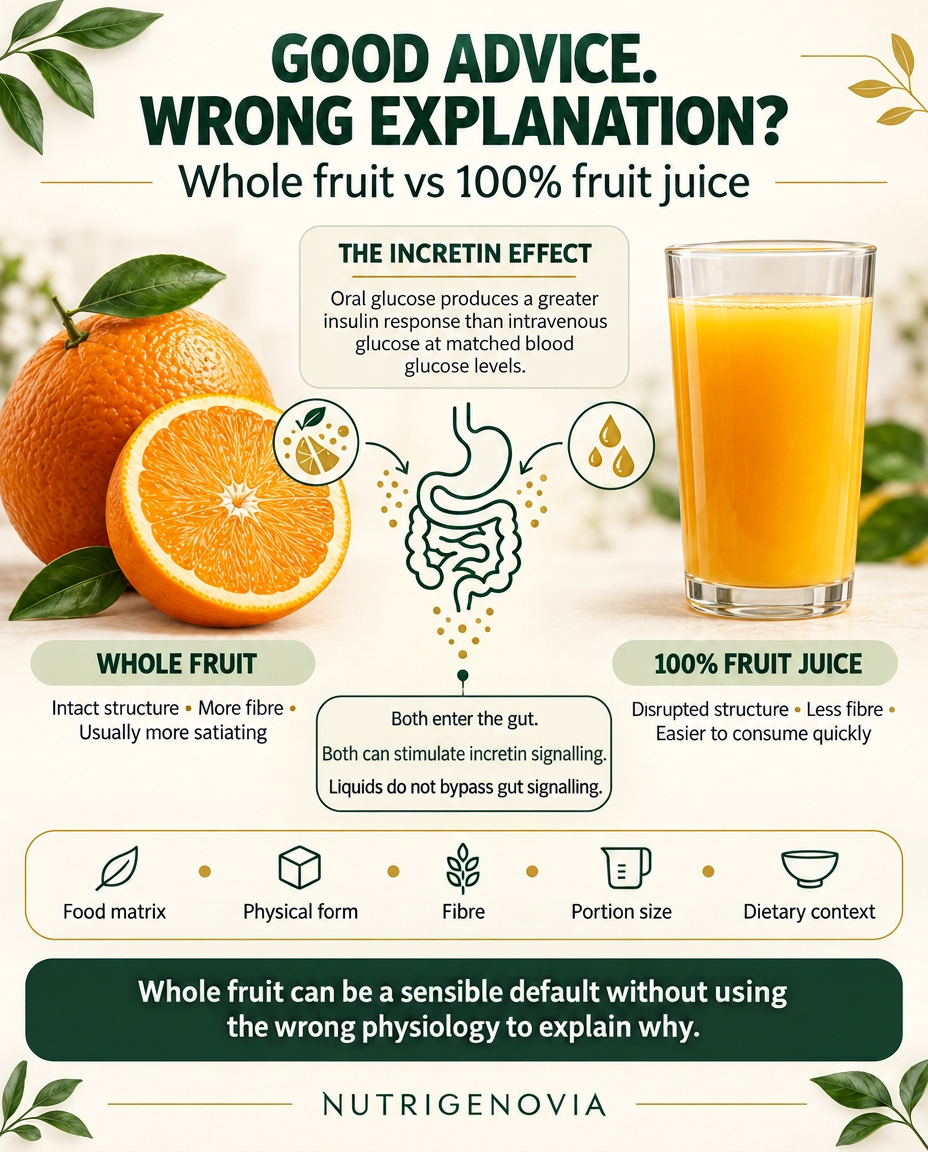
Absolutely.
Take a simple example: whole fruit versus 100% fruit juice.
You may have heard the claim that drinking fruit juice “bypasses” gut signalling, whereas eating whole fruit triggers the release of the incretin hormones GLP-1 and GIP.
That sounds plausible.
But it is not what the incretin effect means.
The incretin effect describes the greater insulin secretory response to oral glucose than to an intravenous glucose infusion that produces matched blood glucose concentrations.
This difference is explained largely by the release of incretin hormones—particularly GIP and GLP-1—when nutrients enter the gastrointestinal tract. These hormones amplify glucose-stimulated insulin secretion.
And this is the important part:
Drinking glucose does not bypass the gut.
A carbohydrate-containing drink still enters the gastrointestinal tract and can stimulate incretin signalling. Its liquid form does not make that physiological pathway disappear.
So, are whole fruit and fruit juice metabolically identical?
No.
There are good reasons to distinguish between them—just not because juice somehow bypasses the incretin system.
Juicing disrupts the fruit’s physical structure, and conventional fruit juices generally contain less fibre than their whole-fruit equivalents. These differences can affect consumption rate and gastric emptying, as well as digestion, nutrient absorption, satiety and postprandial metabolic responses.
They do not, however, mean that whole fruit will invariably produce a lower glycaemic response in every comparison.
In other words, our physiological response to food depends on more than the amount of sugar or carbohydrate shown on a nutrition label.
The food matrix matters.
Physical form matters.
Fibre matters.
Consumption rate and portion size matter.
The wider dietary context matters.
But none of this justifies reducing the difference to another overly simple chain:
juice → glucose spike → crash → insulin resistance
The evidence is more nuanced.
An updated 2025 systematic review and meta-analysis of randomised controlled trials did not detect statistically significant differences between 100% fruit juice and control conditions in the four glucose-metabolism outcomes assessed: blood glucose, HOMA index, insulin and HbA1c.
That does not establish equivalence, prove that every amount of juice is harmless or settle questions about long-term disease risk.
Long-term observational findings are less uniform. One 2025 meta-analysis of prospective cohort studies found no significant association between 100% fruit juice and incident type 2 diabetes (RR 0.98; 95% CI 0.93–1.03), but found a higher risk for the non-100% fruit juice category (RR 1.15; 95% CI 1.03–1.28).
Another 2025 dose-response meta-analysis pooled fruit juice more broadly and reported a small positive association per additional 8-oz daily serving (RR 1.05; 95% CI just above 1.00–1.11).
These are observational associations and cannot, on their own, establish causation.
Current WHO guidance includes sugars naturally present in fruit juice in its definition of free sugars. WHO recommends keeping free sugars below 10% of total energy intake and suggests that reducing intake to 5% or less may provide additional health benefits.
Whole fruit can therefore remain a sensible default choice without exaggerating what fruit juice does to human metabolism.
And this illustrates something much broader about nutrition science:
A recommendation can be reasonable while the explanation used to justify it is wrong.
That distinction matters. Understanding the mechanism helps us move beyond individual foods, headlines and simple rules—and towards a more accurate understanding of human physiology. Sometimes the most useful question is not: “Is this advice good or bad?” It is:
“Does the explanation actually match the physiology?”
References
- D’Elia L, Zarrella AF, Pizzulo IL, Attanasio A, Rendina D, Sievenpiper JL. 100% Fruit Juice Intake, Glucose Profile, and Uric Acid: A Systematic Review. Journal of Medicinal Food. 2025;28(8):743–756. doi:10.1089/jmf.2024.0139. PMID: 40512554.
- Lee CW, Myung SK. Consumption of Fruit Juice and Risk of Type 2 Diabetes Mellitus: A Systematic Review and Meta-Analysis of Prospective Cohort Studies. American Journal of Medicine. 2025;138(10):1428–1437. doi:10.1016/j.amjmed.2025.05.021. PMID: 40393612.
- Della Corte KA, Bosler T, McClure C, Buyken AE, LeCheminant JD, Schwingshackl L, Della Corte D. Dietary Sugar Intake and Incident Type 2 Diabetes Risk: A Systematic Review and Dose-Response Meta-Analysis of Prospective Cohort Studies. Advances in Nutrition. 2025;16(5):100413. doi:10.1016/j.advnut.2025.100413. PMID: 40122386; PMCID: PMC12145082.
- World Health Organization. Guideline: Sugars intake for adults and children. WHO; 2015. Current WHO healthy-diet guidance continues to include sugars naturally present in fruit juices and fruit juice concentrates within the definition of free sugars.