
Does Eating Carbohydrates at Night Automatically Make You Gain More Fat?
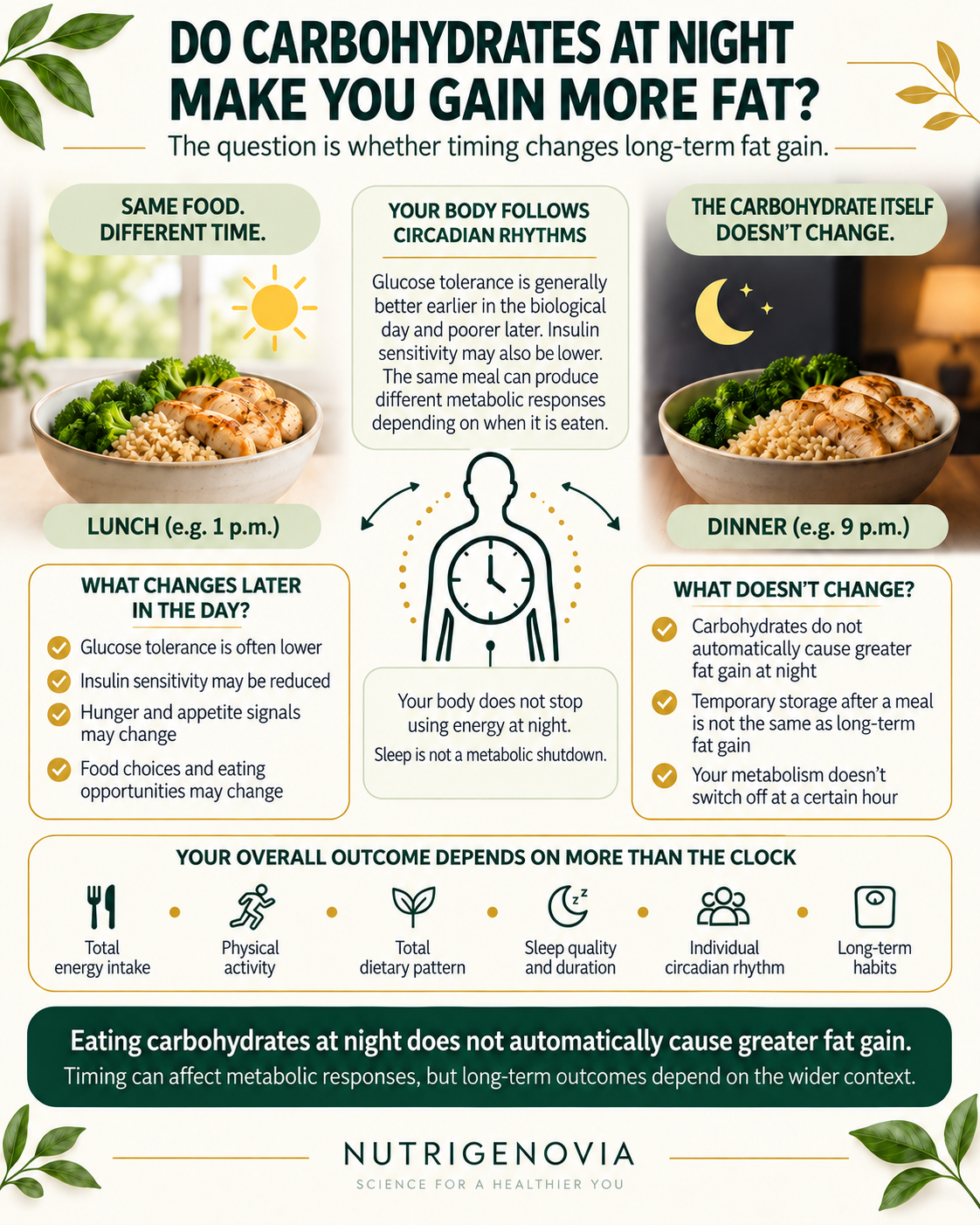
You have probably heard some version of this advice:
Avoid carbohydrates at night.
The usual reasoning is that people are less active in the evening, metabolism slows down and bedtime follows before the energy from the meal has been used. According to this argument, carbohydrates eaten then are more likely to be stored as fat.
That explanation confuses the temporary storage of energy after a meal with the process that leads to a long-term increase in body fat.
Your body does not stop using energy when you go to sleep
Sleep is not a metabolic shutdown.
Your heart continues beating. Your brain remains active. You breathe, regulate body temperature, repair tissues and maintain countless cellular processes throughout the night.
Although energy expenditure generally falls during sleep compared with many waking activities, metabolism does not switch off at a particular hour.
Carbohydrates eaten in the evening do not acquire a special ability to become body fat simply because the clock has passed 6, 8 or 10 p.m.
Your body does pay attention to time
Human physiology follows circadian rhythms — roughly 24-hour biological cycles that influence sleep, hormone secretion, body temperature and metabolism.
Glucose metabolism is part of this pattern.
Controlled studies have shown that the same meal can produce different metabolic responses depending on when it is eaten. Glucose tolerance is generally better in the biological morning and poorer in the biological evening.
Late eating can therefore matter metabolically. It does not follow that:
carbohydrates at night → automatically stored as fat
A different glucose response to a meal is not, by itself, evidence of greater long-term accumulation of body fat.
Most human meal-timing studies change the timing of whole meals, the distribution of daily energy or the length of the eating window. They do not test the effect of eating carbohydrates after a fixed hour as a rule that applies to everyone.
Gaining body fat is a longer story than one evening meal
Our bodies constantly move between storing and using energy.
After a meal, some incoming energy is stored. Between meals and during fasting periods, stored energy can be mobilised again.
This happens every day.
Temporary storage after eating is therefore not the same thing as long-term fat gain.
Long-term gain in body fat requires more energy to be stored than used over time. Meal timing can still influence both sides of that relationship.
In real life, later eating may coincide with, or influence, appetite, sleep schedules, food choices and additional opportunities to eat.
Some small controlled studies have found that shifting otherwise identical meals later can increase hunger or alter energy expenditure and overnight fuel use. Other trials that kept energy intake equal found no difference in total daily energy expenditure or weight loss. Taken alone, these acute and short-term findings do not establish greater long-term fat gain.
They do not show that a bowl of rice eaten at 9 p.m. is, by itself, more fattening than the same bowl eaten at 1 p.m.
What about studies showing benefits from eating earlier?
Nutrition headlines often collapse several findings into a simpler claim.
Recent meta-analyses of meal timing, early time-restricted eating and calorie distribution across the day suggest modest average advantages for earlier calorie distribution or early time-restricted eating for some body-weight and metabolic outcomes.
The results vary by outcome and protocol, and the certainty of the evidence is not uniform. They do not support a universal rule that carbohydrates must be avoided after a particular hour.
Changing meal timing can change several things at once.
People may eat a different amount, fasting periods may lengthen, sleep and appetite may shift, and meals may align differently with circadian rhythms. The distribution of energy across the day also changes.
A benefit from an earlier eating pattern could reflect more than one of these changes. It would not show that:
The body stores nighttime carbohydrates as fat.
The carbohydrate itself is not reading the clock
Imagine two people eating a potato.
One eats it with dinner at 6 p.m.
The other eats it at 9 p.m.
The second potato does not suddenly become a fundamentally different nutrient.
What may differ is the physiological and behavioural context in which it is eaten.
How much has the person eaten during the rest of the day?
What else is in the meal?
How active are they?
What is their sleep schedule?
Is 9 p.m. actually late relative to their biological clock?
Is the evening meal part of a regular pattern — or an additional meal after they have already met their energy needs?
Together, the answers describe the metabolic context more accurately than the idea that carbohydrates become ‘bad’ after a particular hour.
Clock time and biological time are not the same
‘Do not eat after 8 p.m.’ sounds precise.
Biology is less cooperative.
Someone who sleeps from 10 p.m. to 6 a.m. and someone who routinely sleeps from 2 a.m. to 10 a.m. are not necessarily at the same biological point in their day at 8 p.m.
Work schedules, light exposure, sleep timing and individual circadian rhythms complicate any universal rule based on a number on the clock.
A fixed deadline turns a complex physiological question into a rule based only on clock time.
So, should we eat all our carbohydrates at midnight?
No. There are legitimate reasons to study late eating.
Circadian rhythms shape human physiology, and meal timing can influence metabolic responses. Current evidence suggests that habitually concentrating a large share of daily food intake late in the biological day may be less favourable in some contexts. Research continues on eating patterns that align food intake more closely with circadian timing.
These findings do not establish a fixed metabolic rule for evening carbohydrates.
The best-supported conclusion is narrow: eating time can affect acute metabolic responses and may influence body weight over time, although the size and practical importance of the effects vary. No fixed evening hour makes carbohydrate automatically fattening.
For a particular meal, the relevant questions are what changes when it is eaten later and whether the evidence shows that the change matters in practice.
References
- Liu HY, Eso AA, Cook N, O’Neill HM, Albarqouni L. Meal Timing and Anthropometric and Metabolic Outcomes: A Systematic Review and Meta-Analysis. JAMA Network Open. 2024;7(11):e2442163. DOI: 10.1001/jamanetworkopen.2024.42163. PMID: 39485353.
- Chen YE, Tsai HL, Tu YK, Chen LW. Effects of Timing and Eating Duration of Time Restricted Eating on Metabolic Outcomes: Systematic Review and Network Meta-analysis. BMJ Medicine. 2026;5(1):e001071. DOI: 10.1136/bmjmed-2024-001071. PMID: 41586347.
- Fernandes-Alves D, Teixeira GP, Guimarães KC, Crispim CA. Systematic Review and Meta-analysis of Randomized Clinical Trials Comparing Time-Restricted Eating With and Without Caloric Restriction for Weight Loss. Nutrition Reviews. 2026;84(3):463–486. DOI: 10.1093/nutrit/nuaf053. PMID: 40298934.
- Park Y, Cho H, Myung SK. Late Eating and Obesity: A Meta-Analysis of Observational Studies. Nutrition Reviews. Published online 12 June 2026:nuag087. DOI: 10.1093/nutrit/nuag087. PMID: 42287698.
- Morris CJ, Yang JN, Garcia JI, Myers S, Bozzi I, Wang W, Buxton OM, Shea SA, Scheer FAJL. Endogenous Circadian System and Circadian Misalignment Impact Glucose Tolerance via Separate Mechanisms in Humans. Proceedings of the National Academy of Sciences of the United States of America. 2015;112(17):E2225–E2234. DOI: 10.1073/pnas.1418955112. PMID: 25870289.
- Vujović N, Piron MJ, Qian J, Chellappa SL, Nedeltcheva A, Barr D, Heng SW, Kerlin K, Srivastav S, Wang W, Shoji B, Garaulet M, Brady MJ, Scheer FAJL. Late Isocaloric Eating Increases Hunger, Decreases Energy Expenditure, and Modifies Metabolic Pathways in Adults With Overweight and Obesity. Cell Metabolism. 2022;34(10):1486–1498.e7. DOI: 10.1016/j.cmet.2022.09.007. PMID: 36198293.
- Ruddick-Collins LC, Morgan PJ, Fyfe CL, Filipe JAN, Horgan GW, Westerterp KR, Johnston JD, Johnstone AM. Timing of Daily Calorie Loading Affects Appetite and Hunger Responses Without Changes in Energy Metabolism in Healthy Subjects With Obesity. Cell Metabolism. 2022;34(10):1472–1485.e6. DOI: 10.1016/j.cmet.2022.08.001. PMID: 36087576.
- Gu C, Brereton N, Schweitzer A, Cotter M, Duan D, Børsheim E, Wolfe RR, Pham LV, Polotsky VY, Jun JC. Metabolic Effects of Late Dinner in Healthy Volunteers: A Randomized Crossover Clinical Trial. Journal of Clinical Endocrinology and Metabolism. 2020;105(8):2789–2802. DOI: 10.1210/clinem/dgaa354. PMID: 32525525.
- Hall KD, Farooqi IS, Friedman JM, Klein S, Loos RJF, Mangelsdorf DJ, O’Rahilly S, Ravussin E, Redman LM, Ryan DH, Speakman JR, Tobias DK. The Energy Balance Model of Obesity: Beyond Calories In, Calories Out. American Journal of Clinical Nutrition. 2022;115(5):1243–1254. DOI: 10.1093/ajcn/nqac031. PMID: 35134825.
- Vlahoyiannis A, Andreou E, Aphamis G, Felekkis K, Pieri M, Sakkas GK, Giannaki CD. Evaluating the Evening Carbohydrate Dilemma: The Effect of Within-the-Day Carbohydrate Periodization on Body Composition and Physical Fitness. European Journal of Nutrition. 2025;64(1):23. DOI: 10.1007/s00394-024-03540-6. PMID: 39585451.
- Maruthur NM, Pilla SJ, White K, Wu B, Maw MTT, Duan D, Turkson-Ocran RA, Zhao D, Charleston J, Peterson CM, Dougherty RJ, Schrack JA, Appel LJ, Guallar E, Clark JM. Effect of Isocaloric, Time-Restricted Eating on Body Weight in Adults With Obesity: A Randomized Controlled Trial. Annals of Internal Medicine. 2024;177(5):549–558. DOI: 10.7326/M23-3132. PMID: 38639542.
- McHill AW, Phillips AJK, Czeisler CA, Keating L, Yee K, Barger LK, Garaulet M, Scheer FAJL, Klerman EB. Later Circadian Timing of Food Intake Is Associated With Increased Body Fat. American Journal of Clinical Nutrition. 2017;106(5):1213–1219. DOI: 10.3945/ajcn.117.161588. PMID: 28877894.
- Jung CM, Melanson EL, Frydendall EJ, Perreault L, Eckel RH, Wright KP Jr. Energy Expenditure During Sleep, Sleep Deprivation and Sleep Following Sleep Deprivation in Adult Humans. Journal of Physiology. 2011;589(Pt 1):235–244. DOI: 10.1113/jphysiol.2010.197517. PMID: 21059762.